AirTag dog collars: what they can and can't do
An AirTag isn't GPS. How it finds your dog through nearby iPhones, why Android owners can't use it, the anti-stalking alerts, and why you still need ID.
An AirTag on your dog's collar can help you find them — but it isn't a GPS tracker. It has no GPS and no cellular connection of its own. It shows up in Apple's Find My app only when an iPhone, iPad or Mac passes close enough to pick up its signal, so it works best in busy neighborhoods and worst in empty canyons. You need an iPhone or iPad to use one, and Apple designed AirTag for belongings, not pets. Used with that in mind, it's an inexpensive extra layer on top of an ID tag and a microchip.
How an AirTag actually finds things
An AirTag sends out a small Bluetooth signal. Any nearby Apple device in the Find My network — Apple says there are more than a billion iPhones, iPads and Macs — can pick it up and anonymously report its location back to you. Apple says that location data is encrypted and that Apple itself can't see it.
What that means for a dog:
- In a neighborhood, a shopping center or a park full of people, location updates can come in often, because there are lots of iPhones around.
- On a quiet trail, in a canyon or in an open-space area at dawn, there may be no Apple devices nearby — and no updates until someone walks past.
- When you're close, recent iPhones can use Precision Finding to point you toward the AirTag with on-screen directions, and you can play a sound on it.
A GPS tracker with its own cellular plan works differently: it reports its own position on a schedule wherever there's cell coverage. That's a better fit for escape artists, rural properties and long off-leash hikes. An AirTag is a cheaper, no-subscription option that's strongest in towns and cities — which describes most of Orange County.
Android owners: this one isn't for you
To set up and track an AirTag, you need an Apple Account and an iPhone or iPad. There's no way to locate your own AirTag from an Android phone. If your household is all Android, look at a tracker built for Android or a GPS collar instead.
Lost Mode: the most useful feature for a missing dog
If your dog goes missing, mark the AirTag as lost in Find My. Two things happen:
- You get a notification when it's detected by a device in the Find My network.
- Anyone who finds your dog can hold an NFC-capable phone — iPhone or Android — near the AirTag and see the message you left, such as your phone number.
The second point is a good reason to set up Lost Mode right away rather than waiting.
The anti-stalking alerts (and why they matter for dogs)
Apple built AirTag with protections against people being tracked without their knowledge, and Apple and Google worked on a shared standard so alerts reach both iPhone and Android users. In practice:
- An AirTag that's been away from its owner for a while makes a sound when it moves.
- People nearby may get an alert on their phone that an unknown tracker is moving with them.
For a dog, that cuts both ways. If a neighbor takes your lost dog home to keep safe, their phone may tell them there's a tracker on the collar, and the beeping can make the AirTag easier to find. On the other hand, a dog walker, pet sitter or family member may get alerts too. Find My lets you share an AirTag with people you trust, so plan ahead before handing the leash to someone else.
Battery: set a reminder
AirTags run on a standard, user-replaceable CR2032 coin battery, and Apple says it lasts more than a year with everyday use. A dead AirTag is invisible, so swap the battery on a schedule — the start of daylight saving time is an easy one to remember. Coin batteries are dangerous if swallowed, so keep spares away from dogs and kids, and make sure the AirTag is sealed in a secure holder rather than hanging loose where it can be chewed.
Water, sand and holders
Apple rates the AirTag itself IP67 — splash and water resistant, rated for up to 1 meter for 30 minutes. That's fine for rain, sprinklers and a beach day, but it isn't designed as a dive tracker. The holder matters as much as the AirTag: it should keep the AirTag from popping out when your dog shakes, rolls or plays.
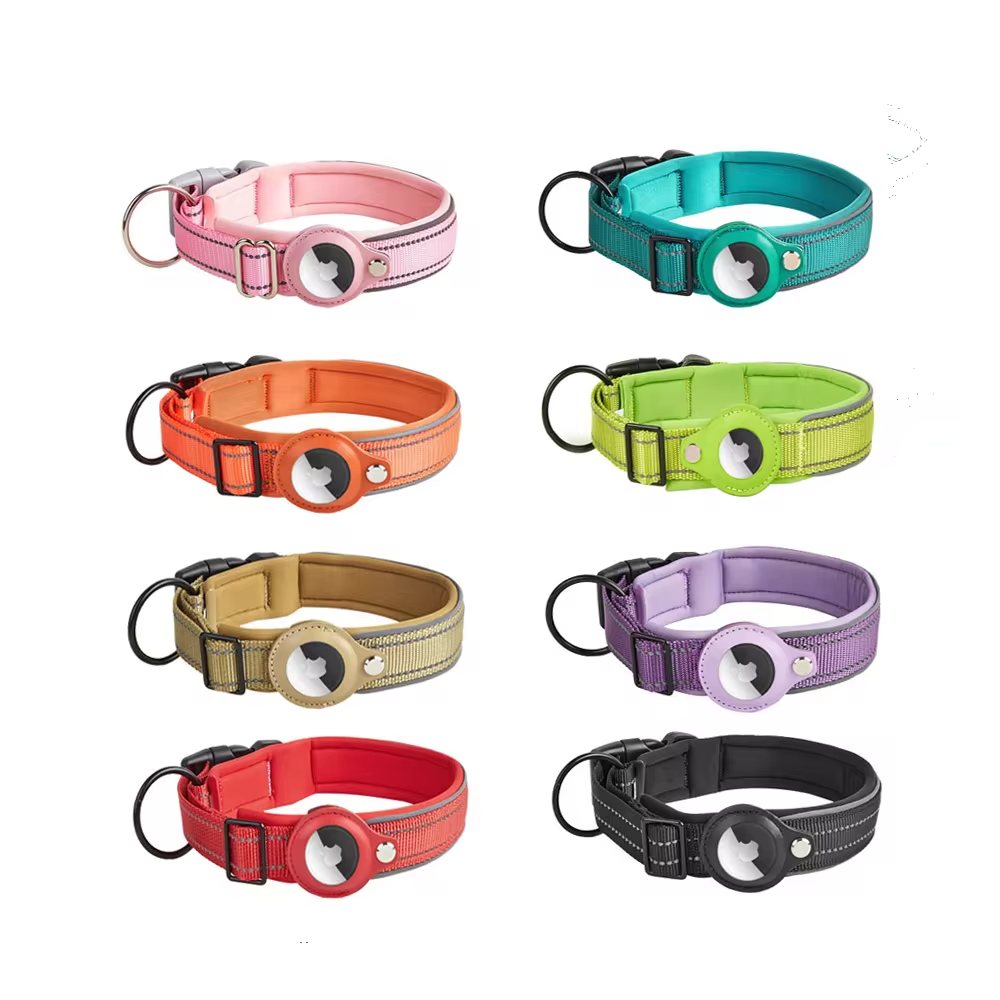
Our AirTag collar is a soft nylon collar with a built-in waterproof holder, so the AirTag sits flat and secure instead of dangling. The AirTag itself is sold separately. Sizes run by neck measurement; leave room for two fingers.
An AirTag is a backup, not your dog's ID
Whoever finds a lost dog usually reaches for the collar first. Make that easy:
- An ID tag with your phone number — it works instantly, with any phone, no app needed.
- A microchip with registration details you've checked this year. Shelters and vets scan for it.
- A current photo of your dog on your phone, and your local shelter's number saved.
The AirTag fills in the gap between "my dog got out" and "someone found my dog" — especially in a busy neighborhood. It doesn't replace the basics.
Frequently asked questions
Is an AirTag a GPS tracker?
No. It has no GPS of its own. It shows a location when a nearby Apple device in the Find My network detects it, so updates depend on how many iPhones, iPads and Macs are around.
Can I use an AirTag with an Android phone?
Not to track it. You need an iPhone or iPad and an Apple Account to set up and locate an AirTag. Android phones can read a lost AirTag's contact message with NFC and can get unknown-tracker alerts.
Will an AirTag on my dog alert strangers?
It can. An AirTag that's away from its owner can play a sound when it moves, and people nearby may get a tracker alert. For a lost dog that can actually help a finder notice it.
How long does the battery last?
Apple says more than a year with everyday use. It's a replaceable CR2032 coin cell — swap it on a schedule so it never quietly dies.
Shop this article
Replies (0)
No replies yet — start the conversation.
Keep reading

airtag dog collar · 6 min read
Best AirTag Dog Collar: What Actually Matters
Looking for the best AirTag dog collar? Here’s what really matters: secure fit, comfort, visibility, and realistic expectations about what AirTag can and can’t do for dogs.
walk · 2 min read
Night walk safety: how to keep your dog visible after dark
With Halloween arriving, expect more noise and trick-or-treaters. Simple ways to keep your dog visible and safe during evening walks in Orange County.

dog-treats · 3 min read
Is It Safe for Dogs to Eat Watermelon? The Rind Trap
Curious if watermelon is safe for your dog? Yes, the flesh is great, but the rind and seeds are not. Here is how to serve it safely in this heat.